Seasonal Nutrition
A Colour-Led Approach to the Weekly Vegetable Selection
Eleanor Whitfield··9 min read
There is an understated habit practised by people who eat well over the long term: a glass of water before the meal. Not as a strategic intervention, not as a weight-management protocol, but as a rhythmic preparation — the quiet signal that eating is about to begin. This article examines what that habit represents compositionally, how it interacts with appetite, and why its simplicity is precisely what makes it durable.
The body's thirst and hunger signals share proximity in their neural origin, and their overlap is well-documented in nutritional research. A state of mild under-hydration — not serious dehydration, simply the gradual fluid deficit that accumulates across a busy morning without conscious water intake — can generate signals that the brain interprets as appetite rather than thirst. A person who has not drunk water since waking may, by mid-morning, experience what presents as hunger when it is more accurately a fluid deficit.
This does not mean that hunger is always misinterpreted thirst — the two are distinct signals with separate physiological bases. But the overlap is real and practically significant. The habit of drinking water before meals addresses it straightforwardly: by arriving at the meal in an adequately hydrated state, the diner can be reasonably confident that the appetite signal they are responding to is not a residual fluid deficit.
The secondary effect of pre-meal water intake is on gastric volume. A standard glass of water (200–250 ml) occupies meaningful volume in the stomach before the meal begins, contributing to the early satiety signal that moderates the speed and quantity of eating without imposing a calorie cost. The effect is modest but consistent across meal contexts — it is not a substitute for adequate food intake, but a complement to it.

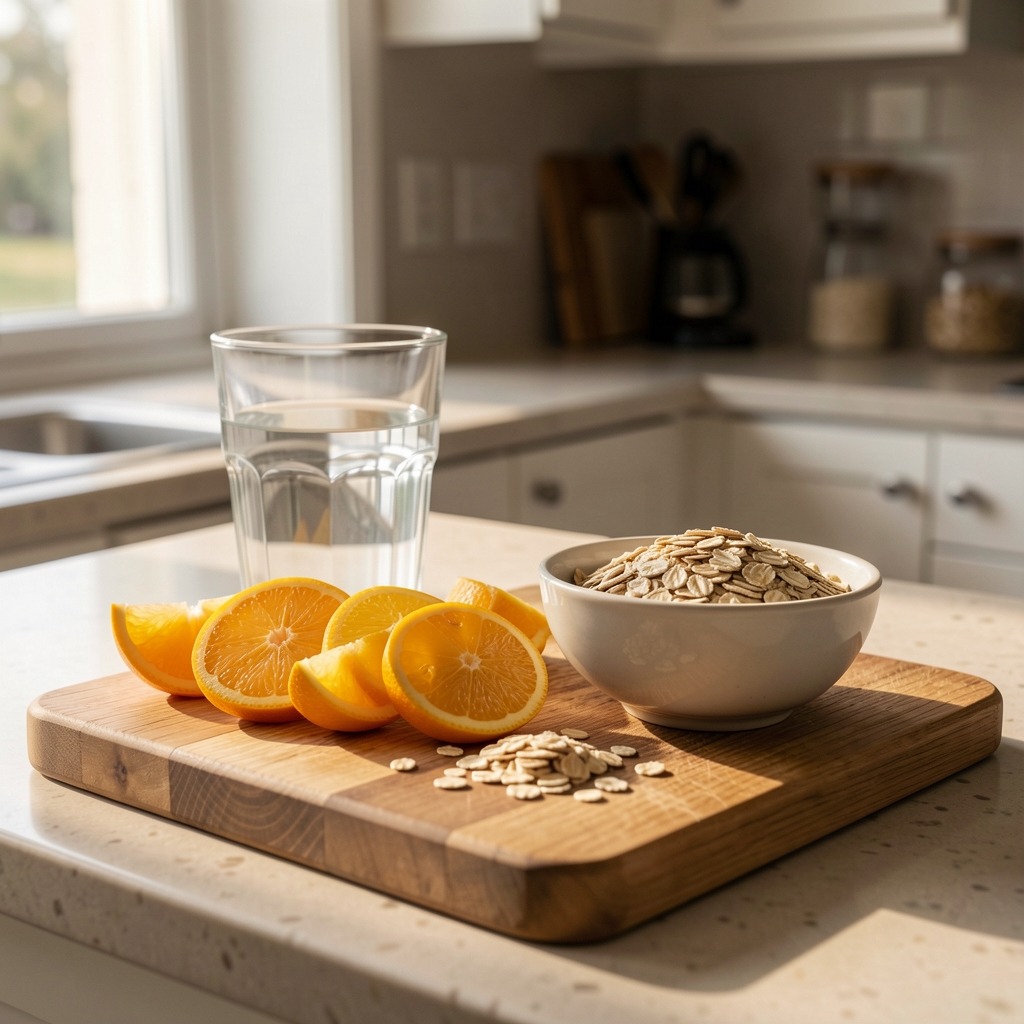
Morning hydration as a kitchen ritual. The glass before the meal is among the simplest and most reproducible daily nutrition practices available.
The challenge with hydration is not knowledge — most people understand that adequate water intake is beneficial — but regularity. Water intake is an easy habit to defer when attention is occupied elsewhere: a focused work session, a commute, a domestic task that runs longer than anticipated. By the time hydration re-enters conscious awareness, several hours may have passed since the last intake.
Anchoring water intake to existing meal habits provides a structural solution. If the glass before each main meal is a non-negotiable element of the meal ritual — as fixed as setting out cutlery — three significant hydration events are built into the day without requiring active memory or willpower allocation. For three meals per day, this contributes 600–750 ml of water intake through the meal-anchoring habit alone.
The total daily fluid intake recommendation for adults in the United Kingdom — approximately 1.5–2 litres per day — requires additional intake beyond the meal-anchored habit. Morning hydration (a glass upon waking, before coffee or tea) and mid-afternoon hydration (a glass before the typical energy dip at around 3pm) complement the meal-anchoring pattern to build a practical daily framework that covers most of the recommended intake without relying on ad hoc drinking throughout the day.
"If the glass before each main meal is as fixed as setting out cutlery, three significant hydration events are built into the day without requiring active memory."
— Phoebe Ashcroft
Water is the default and the simplest option — still or sparkling, at room temperature or cold, with or without a slice of citrus. Tea and coffee contribute to daily fluid intake with the caveat that their caffeine content introduces a mild diuretic consideration at very high volumes (above four to five cups per day); at moderate consumption, published guidance recognises them as contributing positively to daily fluid intake rather than offsetting it.
Herbal infusions — particularly those without added sugar or honey — are nutritionally neutral fluid contributors well suited to the pre-meal ritual in cold months, when cold water is a less appealing option. A cup of fennel, ginger, or peppermint infusion before a meal satisfies both the hydration function and the temperature-comfort consideration without adding a caloric burden.
Fruit juices, even unsweetened, are not a direct substitute for water in this context. Their sugar content — naturally occurring but present — adds a caloric component and a glycaemic consideration that plain water does not. Their position in the daily nutrition framework is better as a component of a meal or snack than as a pre-meal hydration vehicle.
Hydration habits are seasonally influenced in ways that are often underappreciated. Summer activity levels and ambient temperature create a more obvious thirst drive; water intake tends to be higher and more consistent. Winter reduces the thirst signal — the body's perception of fluid need diminishes in cooler conditions even when requirement remains unchanged — and indoor heating creates a background drying effect on respiratory and skin surfaces.
The practical implication is that the meal-anchoring habit becomes more, not less, important in winter months — precisely because the biological prompt to drink is quieter. A framework that operates independently of thirst signal (three glasses before meals, one on waking, one mid-afternoon) provides consistent winter hydration without relying on the reduced seasonal thirst drive to initiate it.
The food-water relationship in winter also shifts compositionally. Soups, stews, and cooked brassicas carry significant water content within their structure — a bowl of vegetable soup contributes to fluid intake in a way that a dry sandwich lunch does not. Seasonal cooking patterns that lean toward water-rich preparations during colder months provide a secondary hydration source that partially compensates for reduced drinking behaviour.

Phoebe Ashcroft contributes quarterly pieces on hydration habits, gut-friendly cooking, and fermented food incorporation. Her editorial approach favours practical kitchen instruction with an emphasis on accessible whole-food preparation.
More from the Almanac